Three Amendments Head to Virginia Voters This Fall

Virginia voters are set to decide three proposed changes to the state constitution this fall, according to reporting from The Center Square. The measures deal with some of the most debated issues in state politics: reproductive rights, voting rights for people with felony convictions, and marriage equality.
Each proposal has already cleared the legislative steps needed to reach voters. The final decision now moves from the General Assembly to the statewide ballot.
The three proposed amendments would:
Add language protecting reproductive freedom in the Virginia Constitution
Change how voting rights are restored after felony convictions
Remove Virginia’s now unenforceable constitutional ban on same-sex marriage and protect the right to marry
Constitutional amendments in Virginia do not go to the governor for approval. They must pass the General Assembly in two separate sessions, with an election in between, and then receive majority support from voters.

The reproductive freedom amendment would put abortion and related care in the constitution
The first proposal would add reproductive freedom protections to Virginia’s constitution. Supporters say the amendment is meant to protect access to abortion and other reproductive health decisions from future political changes.
The proposal comes after the U.S. Supreme Court’s 2022 decision in Dobbs v. Jackson Women’s Health Organization, which overturned Roe v. Wade and returned abortion policy to the states. Since then, state constitutions have become a major battleground over abortion access.
Virginia has not enacted the same level of abortion restrictions as some neighboring Southern states. Still, supporters of the amendment argue that current law can change when control of state government changes. A constitutional amendment would be harder to undo.
The measure is generally described as protecting a person’s right to make decisions related to reproductive health, including pregnancy and abortion. Like many abortion-related constitutional proposals, it also addresses the question of state regulation later in pregnancy.
Backers frame the proposal as a safeguard for personal medical decisions. Opponents argue that the language could go too far and limit the state’s ability to regulate abortion.
That debate is likely to be one of the most visible parts of the campaign. Abortion has been a major issue in Virginia elections since the Dobbs decision, especially in competitive legislative races.
The fall ballot will give voters a direct say on whether reproductive rights should be written into Virginia’s founding legal document.
The voting rights amendment would change restoration after felony convictions
The second amendment deals with voting rights for people convicted of felonies.
Under Virginia’s current constitution, a person convicted of a felony loses the right to vote unless that right is restored. Virginia has long been one of the states where restoration depends heavily on executive action.
Governors from both parties have handled the process differently. Some have moved to restore rights more broadly, while others have used a more case-by-case approach. That has made the policy shift depending on who holds the governor’s office.
The proposed amendment would create a clearer constitutional rule. It would allow voting rights to be restored automatically for people with felony convictions once they are no longer incarcerated, rather than requiring individual action by the governor.
Supporters say the change would make the system more consistent and reduce confusion. They argue that people who have left prison should be able to take part in civic life, including voting.
Opponents say the current process gives the state an important review point before rights are restored. They may also argue that restoration should require completion of more than incarceration, such as probation, parole, or other court obligations.
The amendment would mark a major change in Virginia’s approach. Instead of tying restoration to gubernatorial discretion, the constitution would set the standard.

The marriage amendment would remove outdated language from Virginia’s constitution
The third amendment addresses marriage equality.
Virginia’s constitution still contains language defining marriage as only between one man and one woman. That provision has not been enforceable since the U.S. Supreme Court’s 2015 decision in Obergefell v. Hodges, which recognized same-sex marriage nationwide.
Even though the federal ruling controls current law, the language remains in Virginia’s constitution. The proposed amendment would remove that ban and replace it with constitutional protection for the right to marry.
Supporters say the change would bring Virginia’s constitution in line with current law and remove discriminatory language. They also argue that constitutional protection at the state level matters because federal precedent can change.
The measure is also tied to concerns raised after the Dobbs decision. When the Supreme Court overturned Roe, some advocates worried that other rights based on similar constitutional reasoning could face future challenges. While same-sex marriage remains legal nationwide, supporters of state amendments say added protection is prudent.
Opponents may argue that federal law already protects same-sex marriage, making the amendment unnecessary. Others may object on religious or social grounds.
The amendment is expected to draw attention from civil rights groups, faith organizations, and voters who see the measure as either a legal cleanup or a broader statement about marriage rights in Virginia.
Why these amendments matter beyond one election
Constitutional amendments are different from ordinary laws. A regular law can be passed, changed, or repealed by the General Assembly and governor. A constitutional amendment requires a much more demanding process.
That is why these measures carry long-term weight.
If voters approve them, the changes become part of Virginia’s constitution. Future lawmakers would have less room to reverse course through normal legislation.
If voters reject them, current constitutional language and current legal structures remain in place.
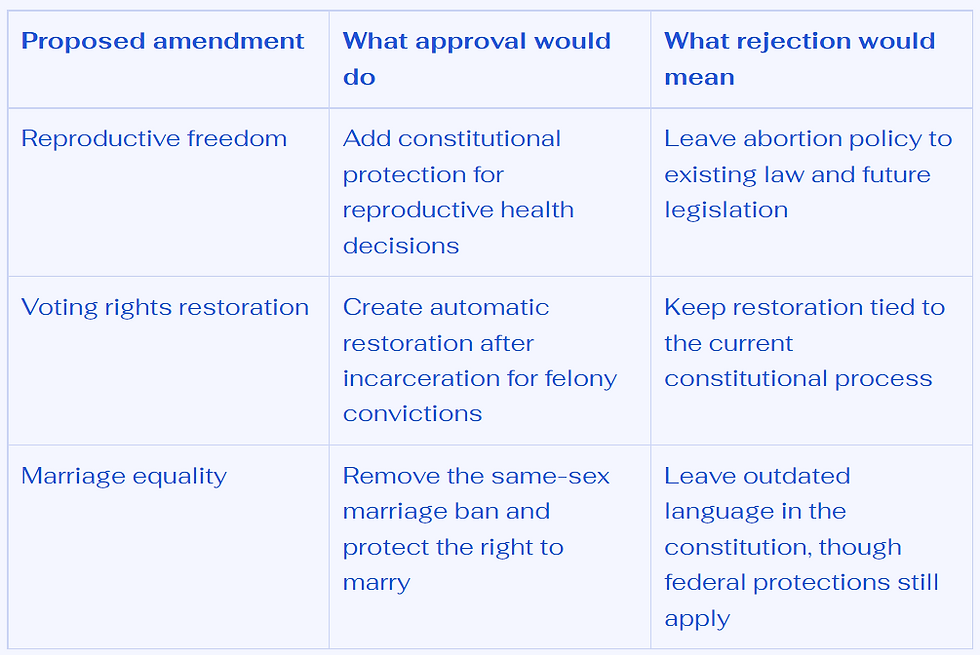
That distinction matters for all three issues:
Proposed amendment | What approval would do | What rejection would mean |
Reproductive freedom | Add constitutional protection for reproductive health decisions | Leave abortion policy to existing law and future legislation |
Voting rights restoration | Create automatic restoration after incarceration for felony convictions | Keep restoration tied to the current constitutional process |
Marriage equality | Remove the same-sex marriage ban and protect the right to marry | Leave outdated language in the constitution, though federal protections still apply |
These questions also give voters a rare direct role in shaping constitutional law. Instead of electing officials who then decide policy, Virginians will vote on the text itself.
The political stakes are high for both parties
The three amendments touch issues that have shaped recent campaigns across Virginia.
Democrats have generally supported all three proposals. They have argued that the amendments protect rights, modernize the constitution, and prevent future rollbacks.
Republicans have been more divided depending on the issue, but many have raised concerns about the scope of the reproductive rights amendment and the voting rights proposal. Some GOP lawmakers have argued that these changes should not be locked into the constitution.
The fall vote could also affect turnout. Ballot measures on abortion, voting rights, and marriage can motivate voters who might otherwise pay less attention to an election.
That is especially true for the reproductive freedom amendment. In several states since 2022, abortion-related ballot measures have drawn national attention and significant campaign spending.
Virginia is often closely watched because it sits politically between the deeper-blue Northeast and the more conservative South. Statewide races are competitive, and ballot questions can become signals about voter mood beyond the state.

What voters should watch before Election Day
The exact ballot language will matter. Voters often hear broad summaries during campaigns, but constitutional amendments turn on the words that appear on the ballot and in the proposed constitutional text.
Before voting, Virginians should look for a few key details.
For the reproductive freedom amendment, the central questions will be how the amendment defines protected decisions, when the state may regulate abortion, and what exceptions apply.
For the voting rights amendment, voters should focus on when restoration occurs and which rights are covered. The public debate may use short phrases, but the legal effect depends on the actual language.
For the marriage amendment, the key issue is how the constitution would define and protect the right to marry, and whether it includes any provisions related to religious organizations or clergy.
Voters should also expect campaign messages from both sides to simplify the issues. That is normal in ballot measure campaigns, but it makes reading the official language more important.
The proposals are not symbolic only. If approved, they would change the state constitution.
The bottom line
The three amendments headed to Virginia voters this fall place major social and civil rights questions directly on the ballot.
One asks whether reproductive freedom should receive state constitutional protection. Another asks whether people with felony convictions should regain voting rights automatically after incarceration. The third asks whether Virginia should remove its same-sex marriage ban and protect the right to marry in the state constitution.
Together, they give voters a direct role in deciding how Virginia defines rights, citizenship, and equality going forward.

The fall election will not just choose officeholders. It will decide whether these three principles become part of Virginia’s constitution.
Original report available from: https://www.thecentersquare.com/virginia/article_c1c66073-92af-4145-8981-9d61b80f2a6c.html
Comments